10 Best Payment Infrastructure Platforms for SaaS in 2026: Complete Comparison
Compare the 10 best payment infrastructure platforms for SaaS in 2026. From Stripe to Paddle to Fungies, find the right payment stack for your SaaS with pricing, features, and use cases.
Here is a stat that will make you pause: 47% of SaaS companies switch their payment infrastructure within the first 18 months. Not because they want to — because they have to. The wrong choice drains margins, creates tax nightmares, and forces engineering teams to build workarounds instead of features.
I have spent years evaluating payment stacks for SaaS businesses. The difference between a platform that scales with you and one that becomes a bottleneck? It usually comes down to understanding what you are actually buying.
What Is Payment Infrastructure for SaaS?
Payment infrastructure is not just about processing credit cards. For SaaS companies, it is the complete stack that handles:
Payment processing — moving money from customer to merchant
Subscription billing — recurring charges, proration, upgrades/downgrades
Tax compliance — VAT, GST, sales tax calculation and remittance
Dunning management — recovering failed payments
Global compliance — PCI DSS, PSD2, local regulations
Some platforms handle everything (Merchant of Record models). Others give you the building blocks and let you assemble the stack yourself. Neither approach is universally better — it depends on your team, your customers, and your growth stage.
Why Your Payment Infrastructure Choice Matters
Pick wrong, and you are looking at:
Hidden costs that eat 2-5% of your revenue
Engineering overhead maintaining billing logic instead of building product
Tax liability exposure if you are the Merchant of Record selling globally
Involuntary churn from poor dunning (failed payment recovery)
Migration headaches when you outgrow your initial choice
The platforms below represent the best options in 2026, ranked by real-world suitability for different SaaS scenarios. I have evaluated them based on pricing transparency, global coverage, developer experience, and operational overhead.
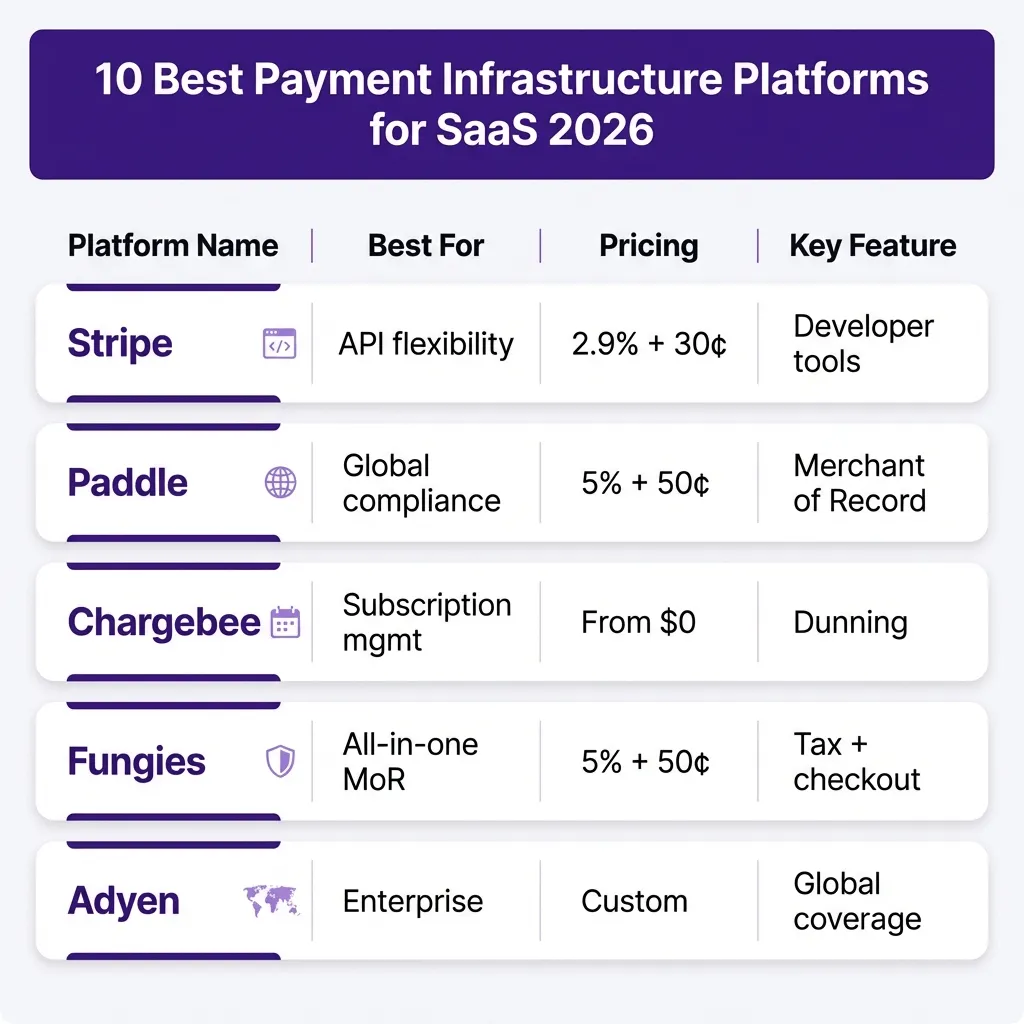
1. Stripe — Best for Developer Flexibility
Stripe remains the gold standard for developer-centric payment infrastructure. Their API design is genuinely best-in-class, and the documentation is what every other platform wishes they had.
Key Features
Comprehensive REST API with SDKs for every major language
Stripe Billing for subscription management
Stripe Tax for automated tax calculation (separate add-on)
Stripe Connect for marketplace and platform models
135+ currencies and 40+ payment methods
Pricing
Online payments: 2.9% + $0.30 per transaction
Stripe Billing: 0.5% on recurring payments
Stripe Tax: 0.5% per transaction (where applicable)
Best For
Technical teams who want maximum control over billing logic and do not mind managing tax compliance separately. Ideal if you have complex usage-based pricing or need deep product integration.
2. Paddle — Best for Global Tax Compliance
Paddle operates as a Merchant of Record (MoR), meaning they become the legal seller of your software. This single distinction removes the biggest headache for SaaS companies selling globally: tax compliance.
Key Features
Full Merchant of Record service — they handle all tax obligations
Global tax compliance (VAT, GST, sales tax) included
Subscription billing with dunning management
Currency conversion and localized pricing
Checkout optimization tools
Pricing
5% + $0.50 per transaction
No monthly fees
No separate tax software needed
Best For
SaaS companies selling internationally who want compliance handled externally. The higher transaction fee often pays for itself in saved accounting costs and eliminated tax risk.
3. Chargebee — Best for Complex Subscription Management
Chargebee sits on top of payment processors like Stripe and adds a sophisticated subscription management layer. It is the tool you graduate to when Stripe Billing’s native features start feeling limiting.
Key Features
Advanced subscription lifecycle management
Flexible pricing models (tiered, volume, stairstep)
Revenue recognition and SaaS metrics dashboards
Configurable dunning logic with customizable retry schedules
Multi-entity support for global operations
Pricing
Free tier up to $250K in cumulative billing
Paid plans from $599/month for higher volumes
Plus payment gateway fees (e.g., Stripe’s 2.9% + $0.30)
Best For
B2B SaaS with complex pricing tiers, usage-based components, or enterprise sales motions. Finance teams love the revenue reporting and audit trails.
4. Fungies — Best All-in-One for Indie Developers
Fungies combines developer-friendly checkout integration with full Merchant of Record protection at a flat, predictable rate. It is designed specifically for indie developers and small SaaS teams who want to focus on building, not billing infrastructure.
Key Features
Merchant of Record with global tax compliance included
No-code checkout builder + developer APIs
Subscription and one-time payment support
Digital product delivery and license key management
Built-in affiliate and referral tracking
Pricing
5% + $0.50 per transaction
No monthly fees
No hidden charges — all tax compliance included
Best For
Indie developers and small SaaS teams who want the simplicity of Paddle with more flexibility for digital products. The flat pricing makes revenue forecasting straightforward.
5. Recurly — Best for Retention and Churn Reduction
Recurly has built its reputation on one thing: keeping subscribers paying. Their dunning and retention tools are industry-leading, and they are obsessive about measuring and optimizing payment recovery.
Key Features
Machine learning-powered retry logic for failed payments
Account updater for expired credit cards
Revenue optimization tools and cohort analysis
Subscription lifecycle management
Integration with multiple payment gateways
Pricing
Custom pricing based on volume
Typically $300-500/month base + transaction fees
Plus payment gateway fees
Best For
Subscription businesses where churn reduction is the highest priority. If you are already at scale and losing 5%+ monthly to failed payments, Recurly’s recovery tools can pay for themselves quickly.
6. Adyen — Best for Enterprise Global Scale
Adyen is the platform behind Netflix, Microsoft, and Spotify. They process hundreds of billions in volume annually and offer the most comprehensive global coverage of any provider on this list.
Key Features
Single platform for online, mobile, and in-person payments
250+ payment methods and 150+ currencies
Direct acquiring relationships in 40+ countries
RevenueAccelerate for authorization optimization
Unified commerce across all channels
Pricing
Interchange++ pricing (variable based on card type)
Typically 2.9-3.5% + fixed fee depending on region
Minimum monthly volume requirements
Best For
Enterprise SaaS with high transaction volumes and global presence. Not suitable for early-stage companies due to volume minimums and implementation complexity.
7. Braintree — Best for PayPal Integration
Braintree, owned by PayPal, offers solid payment processing with one major differentiator: seamless PayPal and Venmo integration. If your customers prefer these payment methods, Braintree is worth considering.
Key Features
Native PayPal, Venmo, Apple Pay, Google Pay support
Recurring billing with vault for stored payment methods
Fraud protection tools
Multi-currency support
Drop-in UI for quick integration
Pricing
2.9% + $0.30 per transaction
No monthly fees
Custom rates for high volume
Best For
SaaS companies where PayPal/Venmo are popular customer payment methods. The subscription management features are basic, so you will likely need additional tooling for complex billing.
8. Checkout.com — Best for Authorization Rates
Checkout.com competes with Adyen at the enterprise level, with a particular focus on maximizing authorization rates (getting transactions approved). Their intelligent routing can meaningfully impact revenue for high-volume businesses.
Key Features
Intelligent payment routing across multiple acquirers
150+ currencies and local payment methods
Real-time data and analytics
Flexible integration options
Strong focus on emerging markets
Pricing
Custom pricing based on volume and risk profile
Interchange++ or blended pricing models
Enterprise-focused
Best For
High-volume SaaS where even small improvements in authorization rates translate to significant revenue. Requires substantial transaction volume to justify implementation.
9. Mollie — Best for European SaaS
Mollie is the European alternative to Stripe. Their API is developer-friendly, onboarding is fast, and they support all major European payment methods out of the box.
Key Features
iDEAL, Bancontact, Giropay, and other EU payment methods
Simple, transparent pricing
Fast onboarding (no lengthy approval process)
Recurring payments support
Strong focus on EU compliance
Pricing
Euro 0.25 + percentage per transaction (varies by method)
Cards: 1.8% + Euro 0.25
No monthly fees
Best For
European SaaS companies wanting local payment methods without complexity. Particularly strong for Netherlands, Belgium, and German markets.
10. Lago — Best Open-Source Alternative
Lago is the new open-source billing platform gaining traction among technical teams. It offers the flexibility of building your own billing system without starting from scratch.
Key Features
Open-source billing API
Usage-based and subscription billing
Self-hosted or cloud options
Event-based metering
Modern API design
Pricing
Self-hosted: Free (open source)
Cloud: Usage-based pricing
Enterprise: Custom
Best For
Technical teams who want full control over billing logic and do not mind self-hosting. Good for companies with unique billing requirements that off-the-shelf platforms cannot handle.
Platform Comparison Table
| Platform | Type | Pricing | Best For |
|---|---|---|---|
| Stripe | Payment Gateway | 2.9% + $0.30 | Developer flexibility |
| Paddle | Merchant of Record | 5% + $0.50 | Global tax compliance |
| Chargebee | Subscription Mgmt | From $599/mo | Complex B2B billing |
| Fungies | Merchant of Record | 5% + $0.50 | Indie developers |
| Recurly | Subscription Mgmt | Custom | Churn reduction |
| Adyen | Payment Gateway | Custom | Enterprise scale |
| Braintree | Payment Gateway | 2.9% + $0.30 | PayPal integration |
| Checkout.com | Payment Gateway | Custom | Authorization optimization |
| Mollie | Payment Gateway | From 1.8% | European markets |
| Lago | Open Source | Free / Cloud | Technical control |
How to Choose the Right Platform
Here is my decision framework after helping dozens of SaaS companies choose their payment infrastructure:
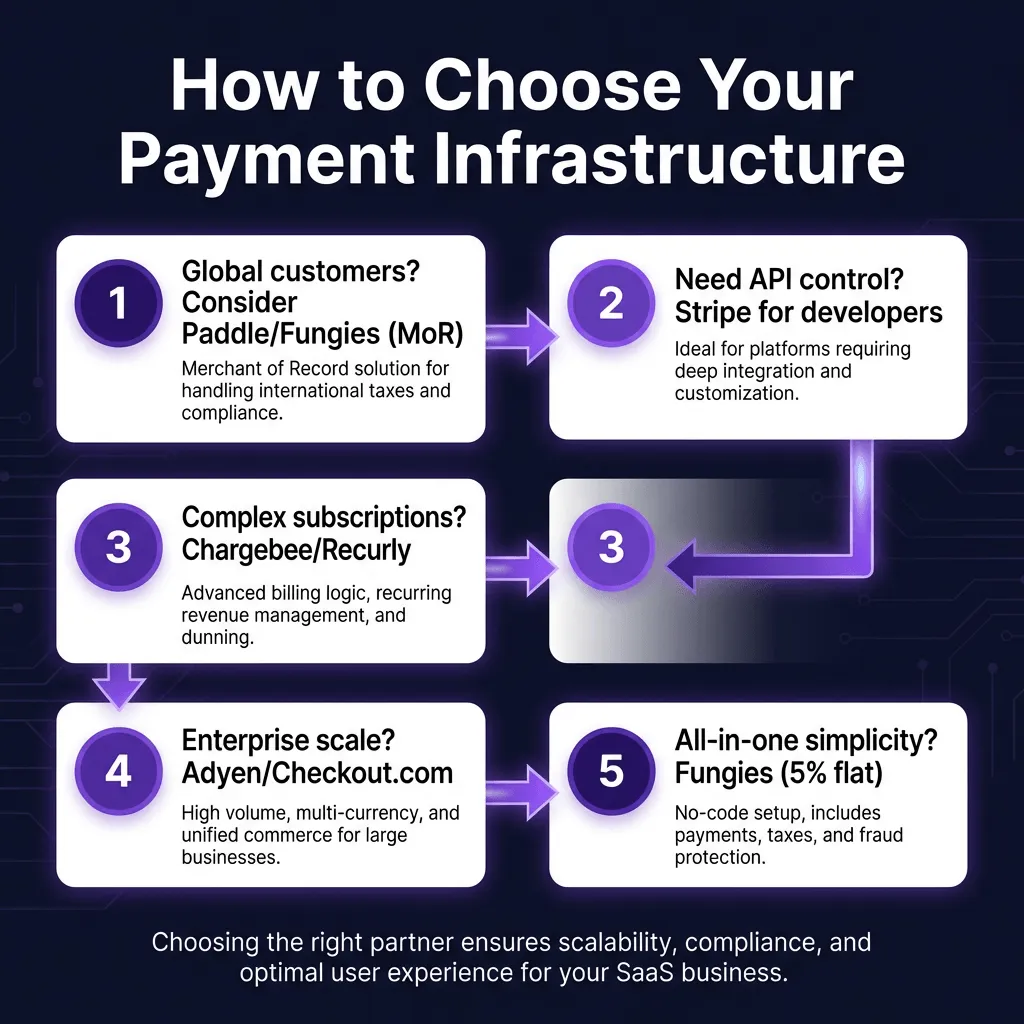
Step 1: Determine Your Merchant of Record Strategy
If you sell internationally, you have two options:
Be your own MoR: Use Stripe/Chargebee + tax software (TaxJar, Avalara). More control, more responsibility.
Use an MoR provider: Use Paddle/Fungies. Less control, zero tax headache.
Honestly, unless you have a dedicated finance team, the MoR route saves more time and money than the fee difference suggests.
Step 2: Evaluate Your Technical Resources
Have engineers to spare? Stripe + Chargebee gives maximum flexibility.
Small team focused on product? Paddle or Fungies gets you running faster.
Need something custom? Lago or building on Stripe’s APIs.
Step 3: Consider Your Growth Stage
Pre-revenue to $10K MRR: Stripe Billing or Fungies
$10K to $100K MRR: Paddle, Chargebee, or Fungies
$100K+ MRR: Recurly, Adyen, or custom stack
Enterprise: Adyen, Checkout.com
Common Mistakes to Avoid
Choosing based on transaction fees alone. A 1% difference in fees matters less than 5% churn from poor dunning or tax penalties from non-compliance.
Ignoring involuntary churn. Failed payments can account for 20-40% of total churn. Platforms with weak dunning (Stripe’s native tools) cost you revenue.
Underestimating tax complexity. Selling to EU customers without VAT compliance is not a risk worth taking. Penalties start at 10% of unpaid tax.
Over-engineering early. Start simple. You can always migrate to a more complex stack as you grow.
FAQ
What is the best payment infrastructure for SaaS startups?
For most SaaS startups, Stripe Billing or Fungies offer the best balance of features and simplicity. If you plan to sell internationally immediately, Fungies or Paddle’s Merchant of Record model removes tax compliance headaches.
Should I use Stripe or a Merchant of Record?
Use Stripe if you have technical resources to manage tax compliance separately and want maximum control. Use a Merchant of Record (Paddle, Fungies) if you want to focus on product and let someone else handle global tax obligations.
How much does payment infrastructure cost for SaaS?
Expect to pay 2.9-5% + fixed fees per transaction. Payment gateways (Stripe, Braintree) start around 2.9% + $0.30. Merchant of Record providers (Paddle, Fungies) typically charge 5% + $0.50 but include tax compliance. Subscription management tools (Chargebee, Recurly) add $300-600/month on top of gateway fees.
What is a Merchant of Record (MoR)?
A Merchant of Record is the legal entity that sells your product to customers. They handle payment processing, tax collection, and compliance. You receive payouts minus their fees. This removes your liability for sales tax, VAT, and other regulatory requirements.
Can I switch payment providers later?
Yes, but subscription migrations require careful planning. You will need to migrate customer payment methods (often impossible to transfer), subscription data, and handle billing continuity. It is doable but disruptive — which is why 47% of SaaS companies end up switching within 18 months when they choose wrong initially.
Final Thoughts
The best payment infrastructure for your SaaS depends on where you are today and where you are headed. There is no universal winner.
If you are just starting, optimize for speed and simplicity. If you are scaling, optimize for retention and compliance. If you are enterprise, optimize for control and coverage.
And remember — you are not just choosing a payment processor. You are choosing who handles your tax liability, how much engineering time you spend on billing, and what percentage of your revenue you keep.
Choose wisely.
Ready to simplify your payment infrastructure? Get started with Fungies and launch your checkout in minutes, not weeks.