10 Best Product-Led Growth Tools for SaaS in 2026: Complete Comparison
Discover the 10 best product-led growth tools for SaaS in 2026. Compare Amplitude, Mixpanel, Pendo, Appcues, Userpilot, PostHog and more. Find the right PLG stack for your stage with pricing, features, and use cases.
Here’s a number that should wake up every SaaS founder: 58% of B2B SaaS companies now run a product-led growth motion, and 91% of them plan to increase that investment this year. Yet most teams are flying blind — they know PLG matters, but they don’t have the right tools to execute it.
I’ve spent years watching SaaS companies burn through engineering cycles trying to build onboarding flows from scratch, or worse — making product decisions based on gut feeling instead of behavioral data. The truth is, you can’t run a PLG motion without the right infrastructure. You need to see what users are doing, guide them to value, and measure what actually drives conversion.
This guide breaks down the 10 best product-led growth tools for SaaS in 2026. These aren’t just analytics platforms — they’re the complete stack you need to turn your product into a growth engine.
What Is Product-Led Growth (PLG)?
Product-led growth is a go-to-market strategy where the product itself drives customer acquisition, activation, retention, and expansion — rather than a sales team or marketing campaign. Think Slack, Zoom, or Notion. Users sign up, experience value immediately, and either convert to paid or invite their team.
Unlike traditional sales-led approaches where you demo the product and negotiate contracts, PLG puts the software in users’ hands from day one. The product becomes your primary sales rep, onboarding specialist, and customer success manager — all rolled into one.
Why PLG Tools Matter in 2026
The PLG landscape has evolved dramatically. According to ChartMogul’s 2026 Conversion Report, the median free-to-paid conversion rate across all PLG models sits around 9%. But here’s the kicker — there’s a 10x difference between the top 20% of self-serve products and the bottom 20%. The companies winning at PLG aren’t just luckier; they’re instrumented better.
The right PLG tools help you answer questions like:
- Which features drive activation and long-term retention?
- Where are users getting stuck in their journey?
- Which accounts are most likely to convert or expand?
- How can you onboard users without manual intervention?
Without these insights, you’re essentially guessing — and in 2026, guessing is expensive.
The 10 Best Product-Led Growth Tools for SaaS in 2026
I’ve organized these tools by category so you can build a complete PLG stack that covers analytics, onboarding, experimentation, and conversion optimization.
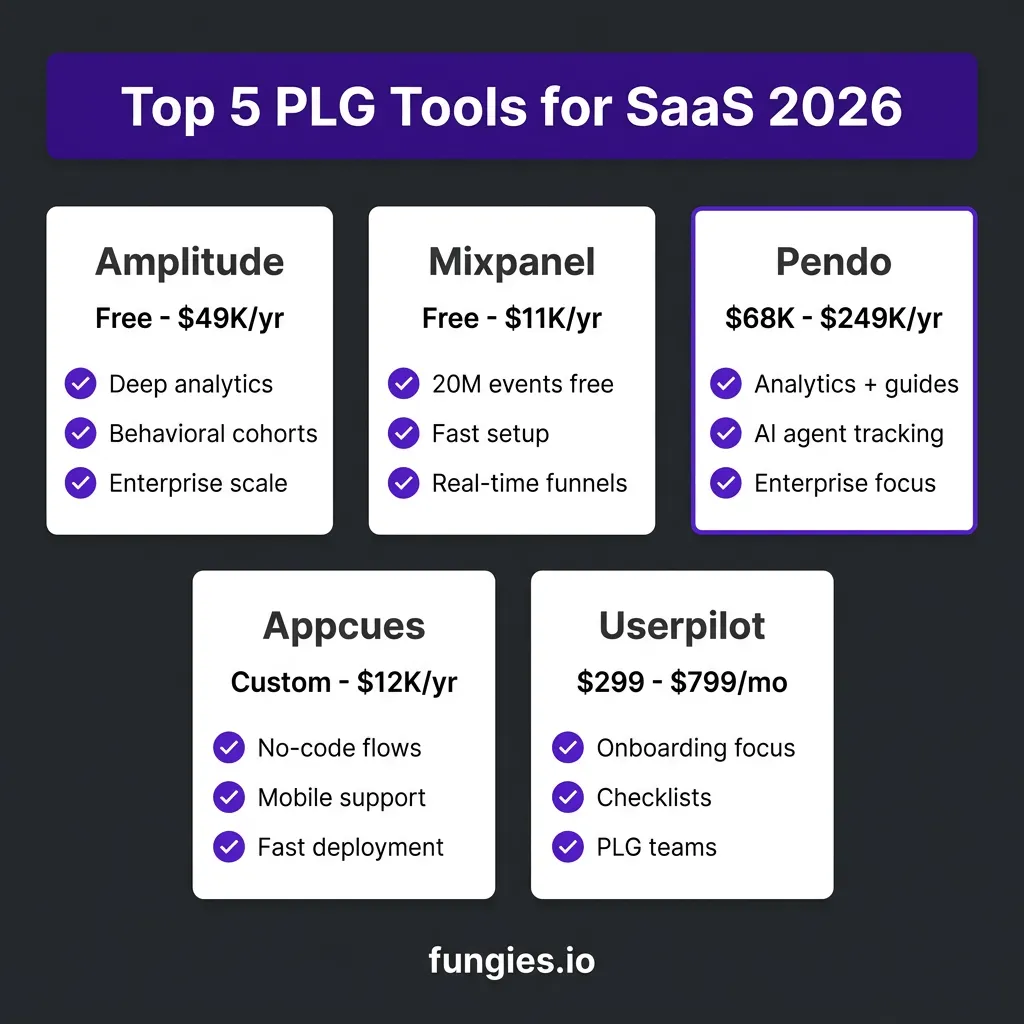
1. Amplitude — Best for Deep Product Analytics
Amplitude is the gold standard for product analytics. It’s built for teams that need to understand user behavior at depth — behavioral cohorts, cross-team collaboration, and rigorous experimentation analysis.
Key features:
- Advanced behavioral cohort analysis
- Funnel and retention analysis with path exploration
- Experimentation and A/B testing built-in
- AI-powered insights and recommendations
- Session replay (added in recent releases)
Pricing: Free Starter plan (generous limits), Growth plans start around $2,000/month, Enterprise typically $49,000+/year.
Best for: Growth-stage and enterprise SaaS teams that need deep analytical capabilities and have dedicated data or product teams.
2. Mixpanel — Best Value for Growing Teams
Mixpanel offers the best balance of power and accessibility. With 20 million events free per month on the Starter plan, it’s the go-to choice for startups that need serious analytics without enterprise budgets.
Key features:
- 20M monthly events on free tier
- Real-time funnel and cohort analysis
- Impact analysis to measure feature effects
- Signal — automatic correlation detection
- Session replay included
Pricing: Free up to 1M events (legacy) or 20M events (Starter), Growth at $0.28 per 1K events after free tier, Enterprise custom. Average SMB pricing around $11,729/year.
Best for: Series A to C startups that need robust analytics without the complexity or cost of enterprise platforms.
3. Pendo — Best All-in-One Platform
Pendo combines product analytics, in-app guidance, user feedback, and roadmapping into a single platform. It’s the choice for enterprise teams that want one tool instead of a fragmented stack.
Key features:
- Deep product analytics with behavioral cohorts
- No-code in-app guides, tooltips, and walkthroughs
- In-app surveys and NPS collection
- Product roadmap and feedback management
- AI Agent Analytics (new in 2026) — track AI agent interactions
Pricing: Contact sales (no transparent pricing). Average SMB pricing around $68,228/year, Enterprise around $249,486/year based on Vendr data.
Best for: Mid-market to enterprise SaaS with dedicated product ops teams and budgets for comprehensive platforms.
4. Appcues — Best for Fast Implementation
Appcues is built for teams that want to ship onboarding experiences fast without engineering dependency. If your priority is launching personalized experiences across in-app, email, mobile, and push quickly, Appcues delivers.
Key features:
- No-code flow builder for onboarding and feature adoption
- Native iOS and Android support (rare in this category)
- Slideouts, tooltips, hotspots, and modals
- User segmentation and targeting
- Basic analytics included
Pricing: Custom pricing based on MAU. Typically starts around $299/month for smaller teams, scaling to $12,000+/year for growth companies.
Best for: Teams that need to move fast on onboarding without waiting for engineering sprints, especially those with mobile apps.
5. Userpilot — Best for PLG-Specific Workflows
Userpilot positions itself as the PLG platform — combining product analytics with in-app experiences specifically designed for product-led growth motions. It’s more focused than Pendo but more analytics-capable than Appcues.
Key features:
- Contextual onboarding checklists
- Resource centers and knowledge bases
- Product analytics with funnel and path analysis
- User segmentation and personalization
- NPS and micro-surveys
Pricing: Starter at $299/month (limited features), Growth at $799/month (full feature set), Enterprise custom.
Best for: PLG-native SaaS companies that want analytics and onboarding in one platform without Pendo’s enterprise complexity.
6. PostHog — Best Open-Source Option
PostHog is the open-source challenger that bundles analytics, session replay, feature flags, A/B testing, and surveys into one platform. For engineering-led teams that want data ownership and transparent pricing, it’s hard to beat.
Key features:
- 1 million events free per month
- Session replay (5,000 free recordings)
- Feature flags and experimentation
- Self-hosting option for data privacy
- SQL access via HogQL for custom queries
Pricing: Free tier extremely generous (90%+ of companies use it free). Pay-as-you-go after limits, with Enterprise at $2,000/month add-on. Average SMB around $10,281/year.
Best for: Engineering-led startups and teams with technical resources who want full data ownership and flexible pricing.
7. Heap — Best for Auto-Capture
Heap automatically captures every user interaction without requiring you to define events upfront. This retroactive analytics capability means you can answer questions about past behavior even if you didn’t think to track it initially.
Key features:
- Automatic event capture — no instrumentation needed
- Retroactive analytics on historical data
- Session replay and heatmaps
- Journey mapping and funnel analysis
- Data science features (predictive models)
Pricing: Free tier available, Growth plans start around $3,600/year, Enterprise custom.
Best for: Teams that don’t know what they need to track yet, or product teams that want to explore data without engineering support.
8. Chameleon — Best for Design-Focused Teams
Chameleon focuses specifically on in-product experiences with deep customization options. If you need onboarding flows that match your brand perfectly and don’t want the bloat of full analytics platforms, Chameleon is worth considering.
Key features:
- Highly customizable tours, tooltips, and launchers
- Deep styling and branding control
- User segmentation and targeting
- Microsurveys and feedback collection
- Transparent pricing (no “contact sales”)
Pricing: Growth plan starts at $279/month, with higher tiers for advanced features.
Best for: Design-conscious SaaS teams that prioritize user experience and brand consistency in their onboarding.
9. ChartMogul — Best for Subscription Analytics
While not a traditional PLG tool, ChartMogul is essential for measuring the business outcomes of your PLG motion. It connects to your billing system and provides deep subscription analytics — MRR, churn, LTV, cohort retention, and more.
Key features:
- Real-time subscription analytics
- Cohort analysis and retention curves
- Churn analysis and revenue recognition
- Custom metrics and segmentation
- Free plan for companies under $120K ARR
Pricing: Free for companies under $120K ARR, Pro at $99/month, Enterprise custom.
Best for: Any SaaS company running PLG that needs to connect product metrics to revenue outcomes.
10. Hotjar — Best for Qualitative Insights
Hotjar complements your quantitative analytics with qualitative insights — heatmaps, session recordings, and user feedback. It’s the tool you use when numbers tell you what is happening, but you need to understand why.
Key features:
- Heatmaps (click, scroll, move)
- Session recordings with filtering
- Feedback widgets and surveys
- User interviews recruitment
- Funnels and form analysis
Pricing: Free basic plan, Plus at $32/month, Business at $80/month, Scale at $171/month.
Best for: Teams that need to understand user behavior qualitatively, especially for UX optimization and conversion rate improvement.
PLG Tools Comparison Table
| Tool | Category | Best For | Starting Price | Free Tier |
|---|---|---|---|---|
| Amplitude | Analytics | Enterprise teams | $2,000/mo | Generous |
| Mixpanel | Analytics | Growing startups | Usage-based | 20M events |
| Pendo | All-in-One | Enterprise PLG | $68K/yr | No |
| Appcues | Onboarding | Fast implementation | $299/mo | No |
| Userpilot | PLG Platform | PLG-native SaaS | $299/mo | No |
| PostHog | Open Source | Engineering teams | $0 | 1M events |
| Heap | Auto-Capture | Exploratory analysis | $3,600/yr | Limited |
| Chameleon | Onboarding | Design-focused | $279/mo | No |
| ChartMogul | Revenue | Subscription analytics | $99/mo | <$120K ARR |
| Hotjar | Qualitative | UX insights | $32/mo | Basic |
How to Choose the Right PLG Stack
With so many options, how do you build the right stack for your stage? Here’s my framework:
Pre-Product-Market Fit (0-100 users)
Keep it simple. Use PostHog (free tier) for analytics and Hotjar for qualitative insights. Don’t over-engineer your stack before you know what to measure.
Early Growth (100-1,000 users)
Add an onboarding tool. Appcues or Chameleon let you build flows without engineering. Keep PostHog or upgrade to Mixpanel for better analytics.
Scaling (1,000-10,000 users)
This is where you need serious analytics. Amplitude or Mixpanel for behavioral analysis, Userpilot or Pendo for onboarding, and ChartMogul to track revenue impact.
Enterprise (10,000+ users)
You probably need Pendo or Amplitude for comprehensive analytics plus in-app guidance. Consider Heap for auto-capture to catch edge cases your instrumentation misses.
Key PLG Metrics to Track
Tools are only as good as the metrics you track. Here are the essential PLG metrics every SaaS should monitor:
- Activation Rate: % of users who reach your “aha moment” — typically 20-40% is good
- Time-to-Value (TTV):strong> How long from signup to first value — aim for under 5 minutes for self-serve
- Free-to-Paid Conversion: 3-5% is good for freemium, 8-12% is great; 10-15% for free trials
- Product-Qualified Leads (PQLs): Users showing high engagement — convert 3x better than MQLs
- Net Revenue Retention (NRR): 120%+ indicates healthy expansion revenue
According to ProductLed’s benchmark survey, companies using PQLs see 3x higher conversion rates than those relying on traditional marketing qualified leads. That’s the power of product-led qualification.
Frequently Asked Questions
What’s the difference between product analytics and PLG tools?
Product analytics tools (Amplitude, Mixpanel) tell you what’s happening in your product. PLG tools often include analytics plus the ability to act on those insights — in-app guidance, onboarding flows, and user communication. Think of analytics as the “measure” layer and PLG platforms as the “measure + act” layer.
Do I need both analytics and onboarding tools?
Not necessarily. All-in-one platforms like Pendo and Userpilot combine both. However, dedicated analytics tools (Amplitude, Mixpanel) typically offer deeper analytical capabilities, while dedicated onboarding tools (Appcues, Chameleon) offer more flexibility in experience design. Many teams start with an all-in-one and graduate to best-of-breed as they scale.
How much should I budget for PLG tools?
For early-stage startups, you can run a solid PLG stack for under $500/month using free tiers (PostHog, Hotjar) plus one paid onboarding tool. Growth-stage companies typically spend $2,000-5,000/month on their PLG stack. Enterprise companies may invest $50,000-250,000/year for comprehensive platforms like Pendo.
Can I switch PLG tools easily?
Analytics tools are harder to switch because they contain historical data. Onboarding tools are easier — you’re mainly migrating flows and user segments. My advice: choose your analytics platform carefully (you’ll likely keep it 3+ years) and be more willing to experiment with onboarding tools.
What’s the #1 mistake teams make with PLG tools?
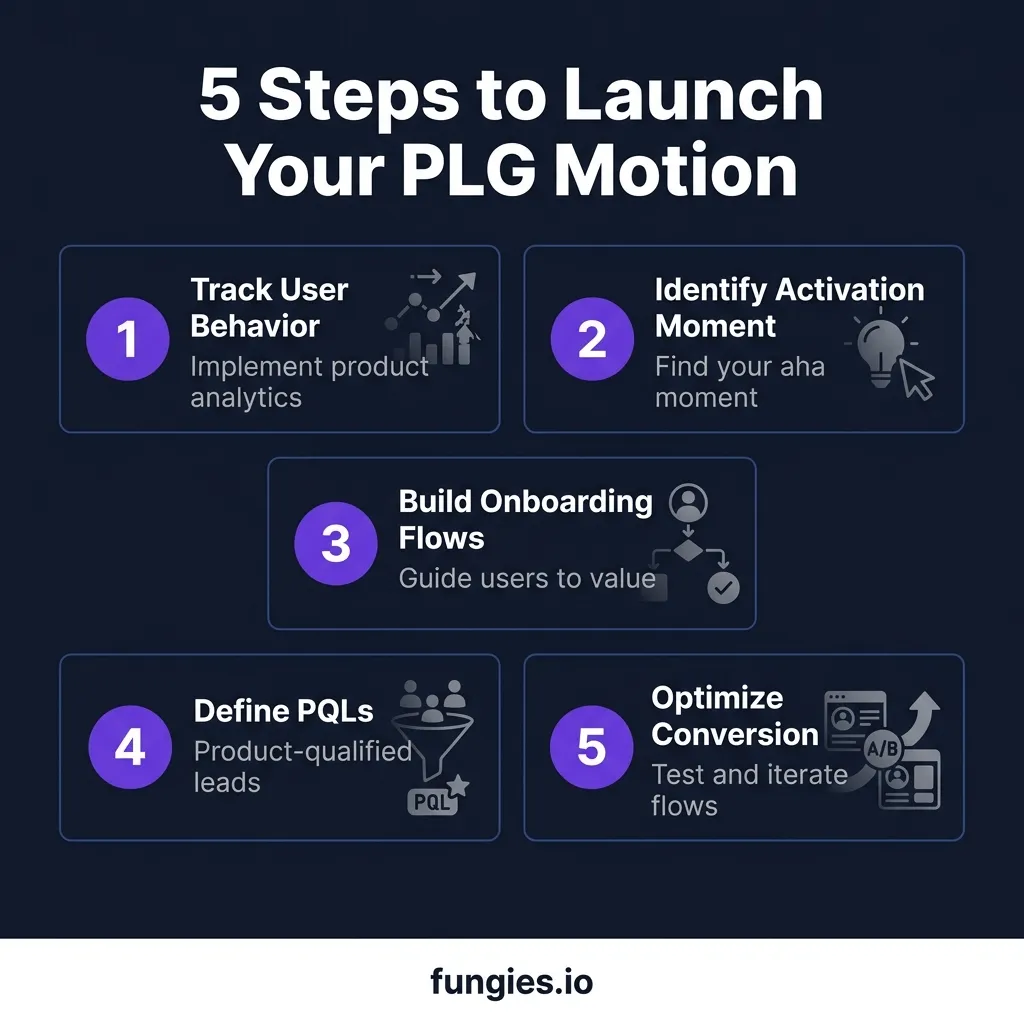
Buying tools before defining their activation moment. You can’t guide users to value if you haven’t defined what “value” means. Before investing in any PLG platform, identify the specific actions that correlate with retention — then buy tools that help you drive users to those actions.
Final Thoughts
Product-led growth isn’t just a strategy — it’s a fundamental shift in how SaaS companies acquire and retain customers. The right tools don’t just measure your PLG motion; they amplify it.
Start with your activation metric. Understand what makes users stick. Then build a stack that helps you guide more users to that moment of value. Whether you choose an all-in-one platform like Pendo or a best-of-breed stack with Mixpanel + Appcues, the key is instrumenting your product so you can make data-driven decisions.
And remember — tools are just enablers. The real competitive advantage comes from how well you understand your users and how effectively you guide them to value. The companies winning at PLG in 2026 aren’t just buying software; they’re building systematic, repeatable growth engines.
Ready to turn your product into a growth engine? Start building with Fungies — the merchant of record platform that handles payments, tax compliance, and checkout so you can focus on building a product that sells itself.
Sources
- ChartMogul SaaS Conversion Report 2026 — chartmogul.com/reports/saas-conversion-report
- ProductLed PLG Benchmarks Survey — productled.com/blog/product-led-growth-benchmarks
- Mixpanel State of Digital Analytics 2026 — mixpanel.com/blog/product-led-growth
- SaaSMag PLG 2026 Analysis — saasmag.com/product-led-growth-next-chapter-saas-2026
- SpendHound Pendo Pricing Data — spendhound.com/marketplace/pendo-pricing
- First Page Sage Conversion Benchmarks — firstpagesage.com